


Huawei used its press conference on Day 1 of MWC Barcelona 2026 to launch a range of products and solutions designed to support future AI-Centric networks, among them new Agentic MBB capabilities.
Setting the scene, Richard Liu, President of ICT Marketing and Solution Sales, Huawei, said that with the pace of AI technology iteration running at a half-yearly cycle, the AI-led transformation is far exceeding market expectations.
“In the future, AI will bring a disruptive impact to the telco industry and change our lives and work,” Liu said. That is why Huawei is advancing the AI-Centric Network.
As an example, during the China New Year Festival 2026, average daily token consumption was almost 8x greater than the year before. Downloads of AI-native apps hit 360 million, doubling this year. This is driving a transformation of industry and consumer experiences, where an internet of agents will provide monetisation opportunities for the telco industry.
To support and meet the growth of agentic AI, Huawei launched a series of solutions to build Agentic Mobile Broadband (MBB).
Agentic MBB
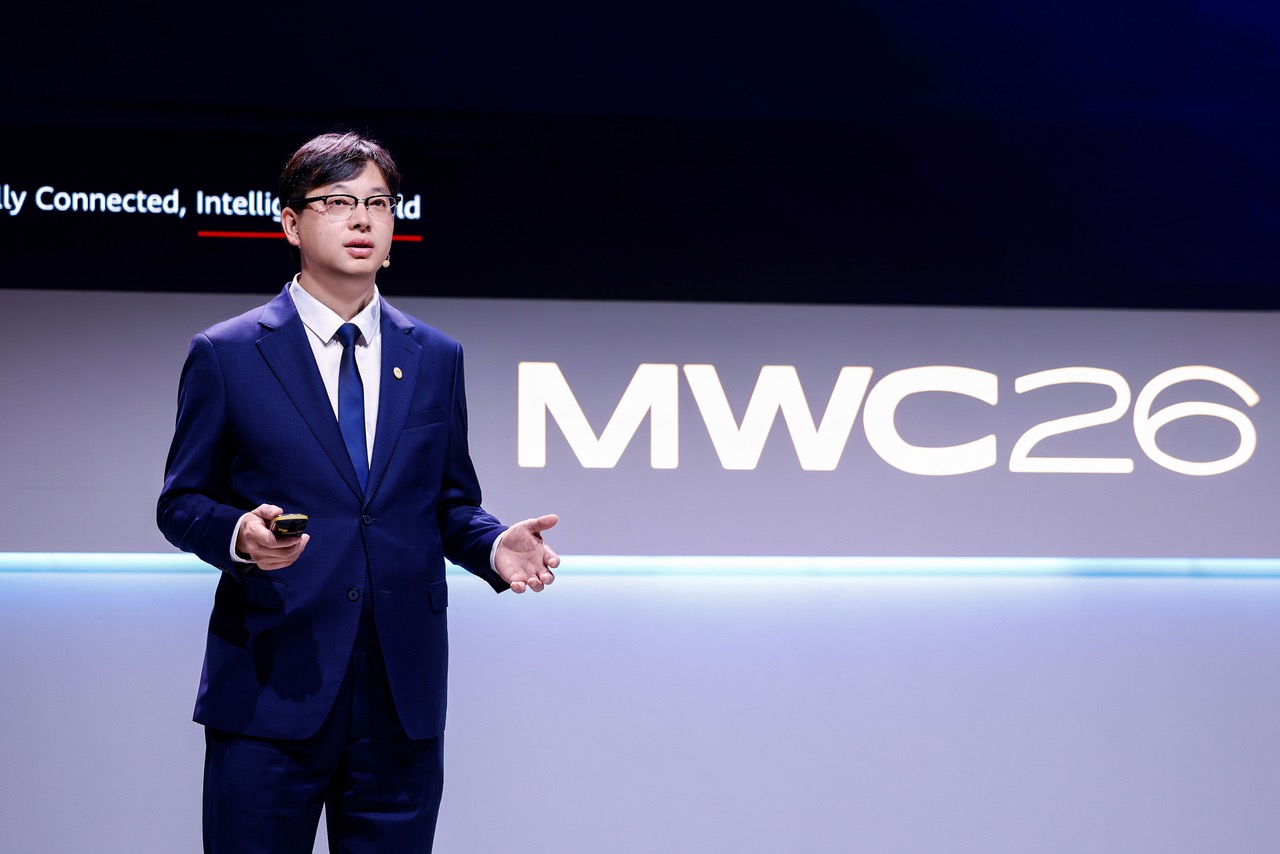
Fang Xiang, Vice President of Huawei and President of Huawei Wireless Solution.
Underlining the need for Agentic MBB, Fang Xiang, Vice President of Huawei and President of Huawei Wireless Solution, highlighted recent trends in agentic AI adoption, referencing recent research (Striding Towards the Intelligent World White Paper: Wireless Network) that global AI agent use will grow by 54% each year. AI agents will evolve to be able to act as autonomous, intelligent decision makers in personal and working lives. With the primary endpoint of communication networks shifting from 9 billion people, there will be 900 billion AI agents by 2035.
This fast growth means network capabilities will be reconstructed to enable multi-dimensional capabilities. Billions of agents will drive uplink capacity demands up to 1Gbps. Real-time co-ordinated agents will also require very low latency, for example humanoid robots need 400 millisecond latency end-to-end.
Resource orchestration will also be reconstructed, with networks being 10x more complex. Real-time co-ordinated agents will also require very low latency, for example a humanoid robot needs 400 millisecond latency end to end.
And there will be a reconstructed interaction paradigm between networks and services, moving to an intent-based model.
Unveiling Agentic MBB, Fang said the Agentic MBB Network is designed as a Service-Oriented System-Level Intelligence, that is driven by an agentic core, agentic capabilities in the Network Layer based on its Telecom Foundation Model and RAN Digital Twin System, and at the Network Element level introduced its advanced Adaptive Air series.
RAN Agent
Agentic MBB combines the company’s Adaptive Air and a world first RAN Agent.
The RAN Agent drives intent-driven single-domain autonomy, providing full-domain awareness and intelligent decision making across the RAN. Fang said that by operating within the RAN Digital Twin System (RDTS), which models equipment, network and environment to use digital intelligence to reshape physical sites, the RAN Agent can build intelligent capabilities across the RAN domain, achieving precise resource matching centred on service intent.
In the northbound direction the RAN Agent collaborates with an operators’ agents via the A2A-T interface to align with business intents and accurately meet the requirements of diversified scenarios. In the southbound direction, it directly connects next-gen Adaptive Air base stations to match network resources with service requirements.
Adaptive Air
Fang also introduced Huawei’s next-generation Adaptive Air solutions. Its GigaGreen Plus radio series uses new materials, techniques, and antenna architecture to simplify hardware while boosting performance and energy efficiency.
“It expands coverage by 15%, sets new benchmarks for energy efficiency, and cuts size and weight by 30%,” Fang said.
Further launches included the 256T U6 GHz AAU, and the tri-band UWB MetaAAU. These are the first to use extremely large antenna array (ELAA), new filters and power amplifiers. Fang said the new U6 GHz AAUs will enable 5G-A to deliver 10 Gbps downlink and 1 Gbps uplink.
The new EasyAAU and industry’s first tri-band 8T8R RRU features disruptive sapphire power amplifiers to pack better coverage and higher capacity into lighter devices with ultra-low power consumption.
Fang also introduced Huawei’s next-gen UBBPi baseband. He said this series doubles energy efficiency per cell, and increases cell capacity 4x. The advanced baseband includes a system-level Chiplet, ultra-heterogeneous parallel processing architecture, and near-memory computing.
“By enabling global intelligent optimisation across time, frequency, and space domains, it handles 20 times the computational complexity. The cell-edge user experience will double and the average experience will be improved by 40%,” Fang said.
Finishing, Fang said, “Let’s work together to catch the opportunities and create greater value in a Fully Connected Intelligent World”
* This is a partner article
