


NVIDIA has claimed that its latest Aerial RAN Computer (ARC) products now deliver better performance per watt than traditional proprietary or ASIC-based RAN systems. And it added that it expects commercial deployments of AI-RAN with leading customers in 2027.
On a call with media, scheduled the day after NVIDIA announced a tranche of lab and field trials with several operators, Ronnie Vashishta, Senior Vice President of telecom, said, “We know that commercial deployments will already start happening next year as trials are being undertaken this year and early next year.”
Vashishta said that trials are about understanding ARC’s AI-RAN performance, ensuring it meets the right KPIs and feature sets, as well as how it integrates within the wider network orchestration and management systems.
“As we have moved through different hardware architectures we have seen performance per watt continue to increase. Last year we said we were able to get performance equivalent to ASIC-based or proprietary RAN. As we’ve moved forward, with partners such as Nokia, we see now that we move beyond the performance per-watt of traditional systems.”
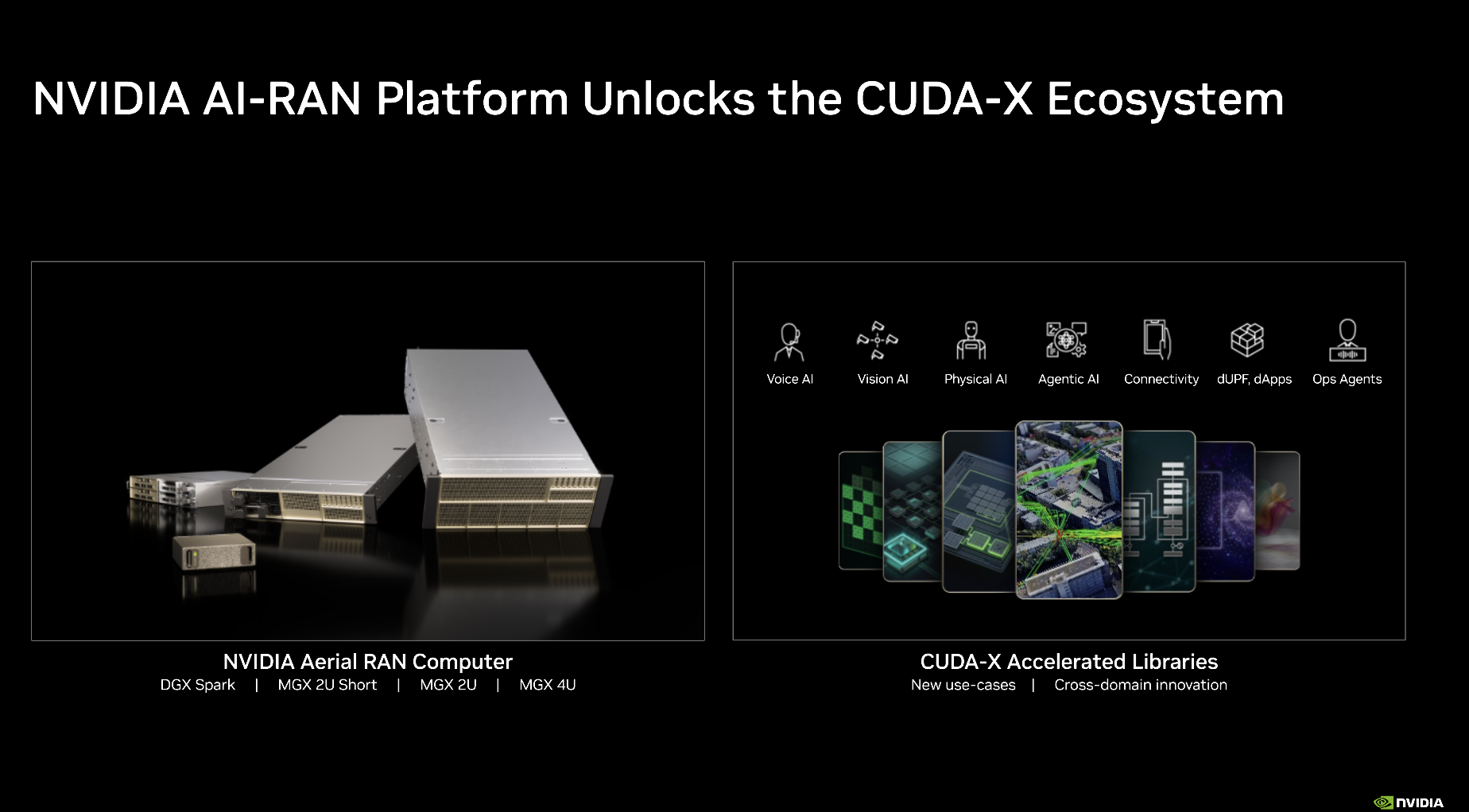
Vashishta also highlighted OEM support for ARC products, with Dell, Super Micro and QCT delivering designs both for C-RAN and on-site deployment.
We see the MGX2U Short being a perfect product for base station deployment
In the C-RAN environment NVIDIA is announcing augmentation to its ARC family with OEM partners integrating MGX 4U and MGX 2U Blackwell server edition infrastructure. Then there is the MGX 2U Short depth for installation at a cell site.
Vashishta also highlighted the DGX Spark version which, while not being deployed in a radio base station, is capable of delivering six sectors of 100 MHz 4T/4R, which he described as a really important product for researchers.
The MGX 2U Short depth, he said, builds on the performance of the previous 2U ARC solution targeted at the cell site – the ARC Compact.
“The ARC Compact is a Grace-based hosted system with a PCIe card. The MGX 2U Short is a step on from that, where we have the RTX Pro 4500 card, so it’s a higher performance per watt than the ARC Compact. Actually a lot of ARC Compact engagements were around early lab trials, and we see the MGX2U Short being a perfect product for base station deployment.”
He added that Elisa has shown that when it ran the MGX 2U Short at the base station, just 30% of the compute was utilised to deliver both RAN software and an edge AI visual application. T-Mobile’s publicised call with Nokia AI-RAN equipment on its live network was also carried out using the MGX 2U Short, Vashista said.
AI-RAN economics
As well as RAN performance calculations – boosted as they may be by the RAN-specific AI workloads that can run on them – operators have economic decisions to make about AI-RAN. Do they think that they can profit from offering AI services to external customers and partners from RAN compute?
Vashishta reiterated NVIDIA’s view that telcos are in the right place to overcome common obstacles to AI business success.
“They have access to power, the last estimate was about 100 GW in their points of presence, switching sites and central offices. Also they have customer and network data. And they have connectivity.”
He added that the nature of telcos’ businesses and network operations makes them very well suited to “the techniques of agentic implementation”.
Partner progress
NVIDIA’s path to AI-RAN deployments in 2027 still looks heavily reliant on its strategic partnership with Nokia. Most of the trials NVIDIA mentioned named Nokia as the RAN provider, and Vashishta pointed out that Nokia now has around 19 carrier engagements on AI-RAN.
Asked what other RAN players NVIDIA could point to, Vashishta named the work the company does with Samsung, as well as its work within OCUDU, which is based on open source RAN software from the former SRS-RAN. He also mentioned O-RAN Development Company (ODC) as another RAN partner.
On Wednesday 21 October, NVIDIA had released details of a number of ongoing and future operator trials of its AI-RAN products.
Many of the releases from partners mentioned carrying out tests to verify Nokia’s claims for special efficiency gains delivered by its AI-RAN channel estimation and other algorithms. Most also highlighted distributed deployment models, including Elisa’s approach, as Vashishta described.
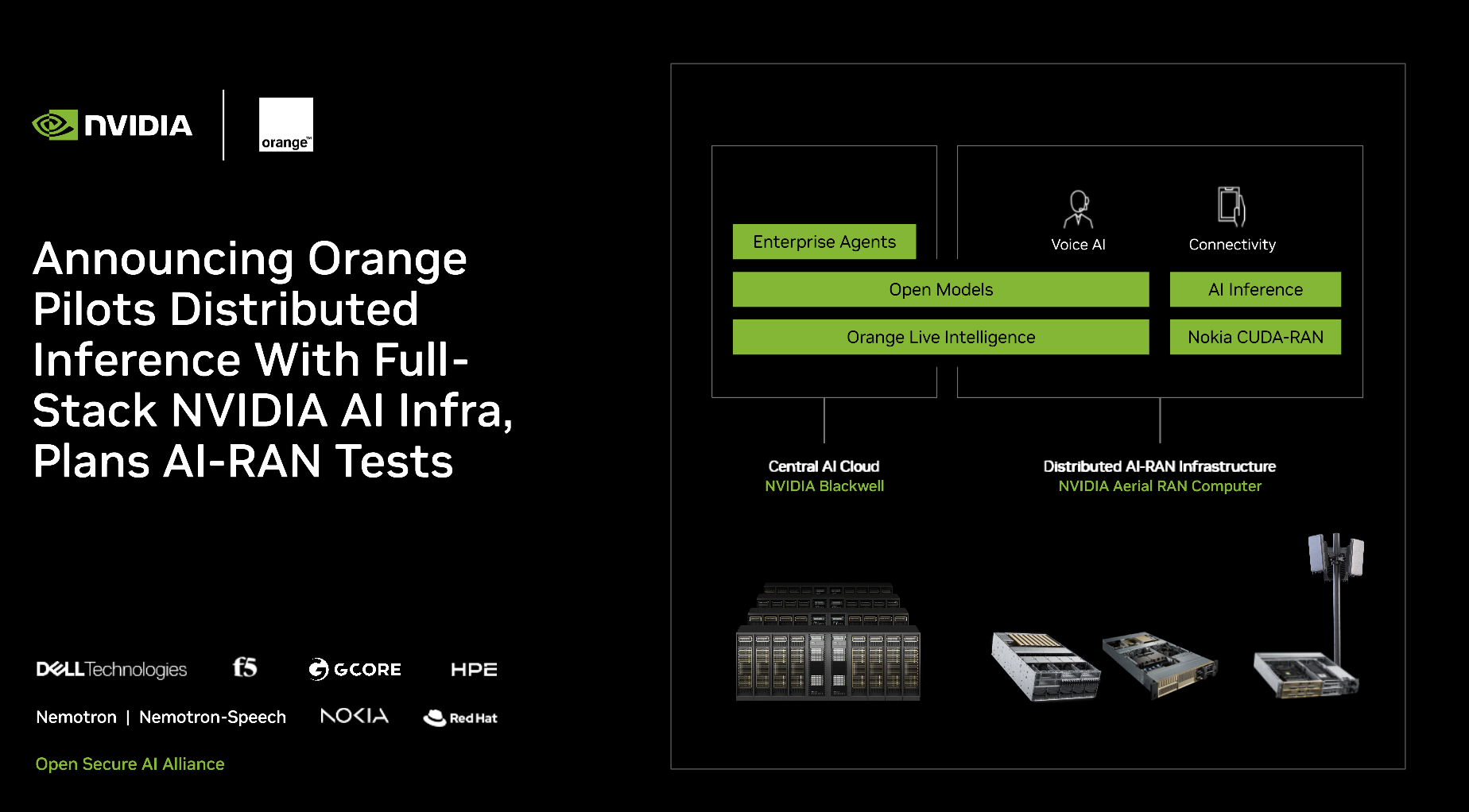
Some also mentioned testing distributed inference and AI models at those sites. As well as Elisa’s visual application, Orange Business deployed both centralised and distributed versions during its tests, which included the hosting of a live AI-powered voice translation application as it tests out distributed inference, integrating open NVIDIA Nemotron models into Orange’s Live Intelligence AI multi-LLM platform. Orange is also assessing AI-RAN performance with Nokia and NVIDIA, focusing on potential gains in radio spectral efficiency, network capacity and site economics.

Comments
0