


It looks like we may have an answer the question of how Deutsche Telekom is going to meet its requirement to develop an independent RAN configuration software layer. A release this morning said that DT and Capgemini have signed an MoU for CapGemini to develop “a unified, open platform for intelligent Radio Access Network (RAN) automation”.
The companies said the Capgemini platform will act “as a Service Management and Orchestration (SMO) that operates consistently across O-RAN but also legacy RAN environments, including 5G and 4G for Deutsche Telekom’s European segments.”
As well as deploying it across Europe, the operator said the companies are also readying it for the global market as a software service for operators worldwide.
That, then, will give DT a RAN management platform, including a RIC for rApps, that can in theory manage its whole RAN estate. Why does this matter?
If you remember the story so far, it goes something like this. It’s November 2024, and Deutsche Telekom still has quite a lot of Huawei equipment in its radio network. The government was keen to see the potential strategic or security impact of that reduced or eliminated. A compromise of sorts was struck – DT could keep the Huawei radios and antennas at the sites, but the software that manages them would have to be replaced with something independent. As part of the deal struck with the government, DT said it would be making its own RAN configuration manager, describing it as an in-house development. It would have to do this by 2029.
In fact back in 2021 the operator had already committed to developing a “vendor-independent Service Management and Orchestration (SMO), using ONAP open source as the foundation, for service automation across all network domains.” Deutsche Telekom said it was developing the SMO to be the centre piece for full life-cycle management (LCM) of all O-RAN components. So it already had something to work with, due to its open source developments. Would this be the platform to go forward and become the production implementation across its RAN estate?
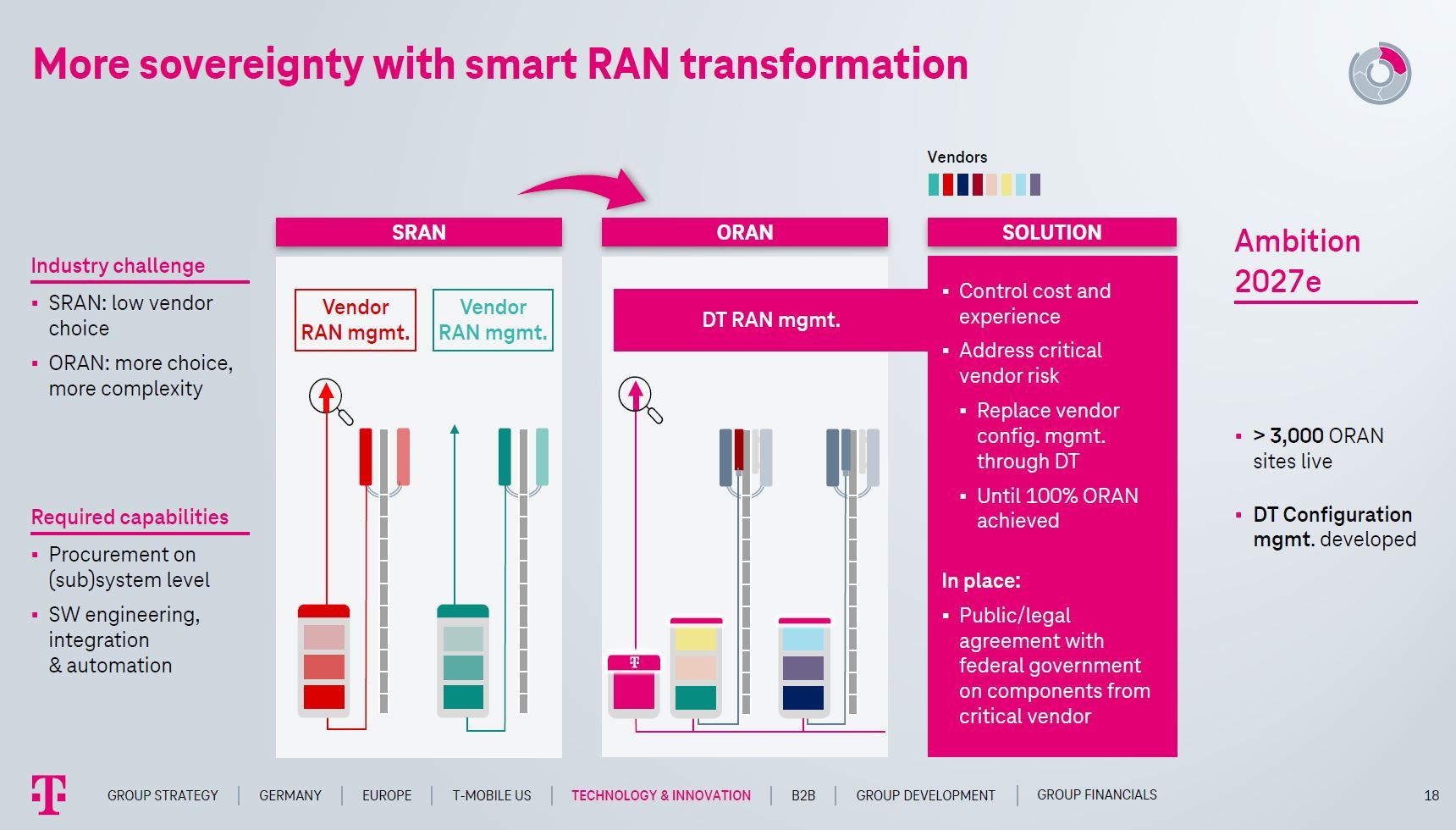
Also in November 2024, DT announced that it would be giving Nokia three thousand sites in Germany, which would be built according to Open RAN principles. In that announcement it said that Nokia would also be bringing its MantaRay SMO, which is Nokia’s Open RAN management platform.
How, then, would that align with DT’s intention to develop its own SMO. DT told TMN at the time that its vendor-independent SMO was still in development.
It said, “Our phased O-RAN approach at DT has three key pillars, starting with Open fronthaul (OFH) adoption as implemented in this multi-vendor O-RAN deployment with Nokia and Fujitsu – which currently includes Nokia’s MantaRay solution. The other two pillars on our journey, namely the development of our vendor independent management (SMO) for the handling of SRAN as well as O-RAN infrastructure and implementing cloud RAN are still in development phase.”
The operator did confirm that it wants to implement a vendor-independent SMO, saying, “Our ambition is to operate our RAN networks using our common RAN vendor independent management system (SMO).”
Logically then, that would either put Nokia’s network management system underneath DT’s vendor-independent SMO, or it would be replaced by the new SMO.
Enter Capgemini
Now we have a new SMO announcement – with Capgemini – which raises the obvious question. How does this align with the in-house development of the platform? It could be, of course, that the Capgemini platform incorporates elements that DT has worked on to date. Or it could be a separate development path.
Certainly, this seems to be the platform that DT has settled on for management of the RAN worldwide, according to this quote from Thomas Lips, SVP RAN, Disaggregation and Enablement.
UPDATE:
Following an enquiry, DT confirmed to TMN : “Our long term strategy is to build and implement a vendor independent SMO for centralized control of multi RAN environments, both Open RAN and traditional RAN. We are taking a phased approach towards that goal, and have been implementing elements as we go based on the business requirements. And Capgemini, who bring in their non RT RIC asset, will partner with us for further joint engineering and scaled developing of the full SMO platform.”
“A vendor-independent, standards-compliant SMO is fundamental to the evolution of how we operate our radio access networks,” said Lips. “Together with Capgemini, we are engineering an SMO platform that brings intelligence and automation across both Open RAN and legacy SRAN environments. Shaped by real operational experience, the platform is built for multi-vendor networks. As we prepare to roll it out across Deutsche Telekom’s entire European footprint, we are also together readying it for the global market as a software service for operators worldwide.”
Capgemini and Deutsche Telekom will showcase the solution at Mobile World Congress in Barcelona, where we can search for more answers.
